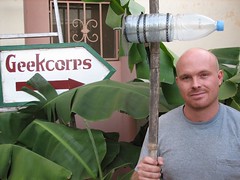
 It was my last afternoon in Mali, as I started psychic re-entry process into my normal existence, that I remembered that in real life, hey, I'm a geek. So I dropped by the offices of GeekCorps Mali, which as it turned out was just around the corner from where I was staying at Rebecca and Fode's house in the Quartier Hippodrome. And project director Matt Berg took time to show me around their labs and talk to me about their work. It was my last afternoon in Mali, as I started psychic re-entry process into my normal existence, that I remembered that in real life, hey, I'm a geek. So I dropped by the offices of GeekCorps Mali, which as it turned out was just around the corner from where I was staying at Rebecca and Fode's house in the Quartier Hippodrome. And project director Matt Berg took time to show me around their labs and talk to me about their work.
GeekCorps Mali (GCM) is a USAID-funded project whose mission is to provide appropriate technology, technology transfer, and technical assistance in Mali. Matt showed me some of their innovations in the "appropriate technology" arena and they knocked my socks off. Like Bottlenet - a Wifi antenna built out of low-cost, locally available components and assembled in one of Mali's ubiquitous 1.5 liter mineral water bottles.
When we visited some villages in the Malian countryside I was surprised that children always asked us for our empy water bottles, till I saw them in use at local wells, where girls were refilling them from the pump. In the village of Amani in Dogon Country some Fulani women sold us a few liters of fresh cow's milk in a couple of these water bottles. (wow - was that good - and really helped to settle my stomache, which was somewhat agitated after days of pouring hot Malian pepper sauce on everything I ate.) Then I saw them being used with their bottoms cut off as funnels and as spigots on wells. But using them as a wave guide takes it to an entirely new level.
Another problem we witnessed first hand in Timbuktu is the near impossibility of keeping the Sahelian dust and sand out of computers. Geekcorps has addressed this by designing the Desert PC, a completely sealed system unit employing a low-power CPU and a heat-sink system that in effect uses a built in "radiator" rather than a fan to cool the device. Largely based on Geekcorps award-winning desgin, Via Technologies, whose components Geekcorps used in their prototype, is now selling the PC1 for use in desert conditions.
Matt also stressed that on all their projects GCM uses Malian volunteers - so that the tech skills employed will be transfered to folks living in the country. The big success story in this area is a young man named Moussa Keita, who has gone on from his volunteer work with GCM to found his own web development company, Zirasun.Labels: geekcorps, mali, nptech, wifi |


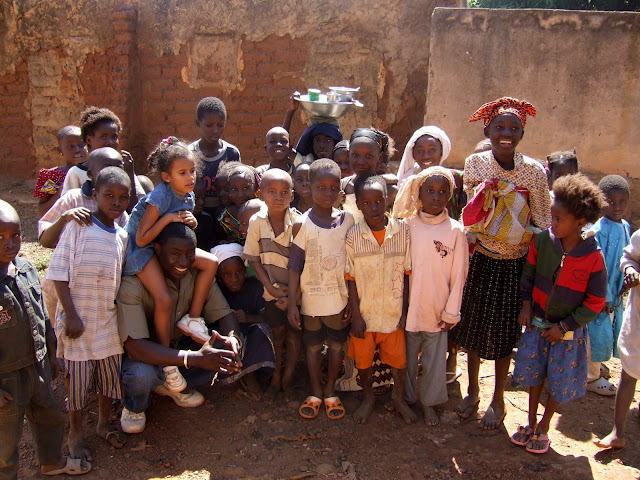 Last month I wrote about my stroll through Sikoro, on the northern outskirts of Bamako, Mali, and the community health project Siguida Keneyali we learned about there. Today my friend Britt Bravo posted an in-depth interview with Caitlin Cohen of Siguida that looks at the project and its community-based orientation in some real detail. I'm sure you'll find it a worthwhile read!