Members Only Logo  
XML

or Subscribe by Email by entering your address below:


Powered by FeedBlitz
Learn about Subscriptions Follow me on Twitter!

The topics discussed here grow out of the bread-and-butter issues that confront my consulting and software clients on a daily basis. We'll talk about prosaic stuff like Membership Management, Meetings and Events Management and Fundraising, broader ideas like security and software project management, and the social, cultural, and organizational issues that impact IT decision-making.

Powered by Blogger


Friday, March 21, 2008

The Humane Society's LOLseals

But before we get back to delivering IT projects on time, let's look at some funny pictures.
Certainly none of us have been spared the LOLcats phenomenon - where folks photograph cats and give them funny captions. Here's one my god-daughter Leah posted on Facebook, for example:

Taking off on the popularity of this craze, my friend Carie Lewis, the dynamic internet marketing manager for the Humane Society of the US - one of the most savvy non-profits around when it comes to interactive and social media - has launched an LOLseals contest on the HSUS website. Take a peak.


The idea is to create your own caption for one of the seal pictures. A panel of celebrity judges will announce a winner, who will take home a bunch of great HSUS seal gear. It's a great idea to encourage engagement and awareness of the ongoing plight of Canadian seals.

What is exciting about this contest is the way it changes the images used in educating folks about the seals. The Canadian Seal Hunt is still the worlds largest slaughter of marine mammals. And it happens every year. We are all used to seeing images of baby seals being clubbed. This campaign reminds us of how appealing these animals are, rather than forcing us to look at violent images we've learned to shield ourselves against over the years. It gives the community a new way to engage with the issue, a new way to feel about these animals. It can be hard to find a new way of presenting the same old story - HSUS has found a way here.

Labels: ,

Tuesday, October 16, 2007

Measuring the Return from of Social Media.

A few years ago, when web tools were just beginning to allow the interactive environments we're seeing everywhere today, I wrote a piece called Bread and Butter 2.0. In it I juxtaposed the excitement technologists were trying to communicate about web 2.0 features with the more prosaic "bread and butter" technology issues that non-profits were struggling with. But times have changed - and more organizations are learning that social media can help deliver those bread and butter goals of building and maintaining a base of donors, volunteers, and supporters. And importantly, the return on investment in these technologies can be measured in terms of donations, page views, and names who receive your updates.

For example, the ASAE (American Society of Association Executives) just ran an article called Expand your Audience through Social Media. Largely an interview with Jonathon Colman of The Nature Conservancy, the article focuses on how building trust and presence in online communities can build actual, countable page views on your website: Jonathon describes a campaign where his social networking promotion of a website article earned it 16 thousand views in a single day. Seems pretty bread and butter to me.

Fundraisers are starting to pay attention to social media as well. An article in Fundraising Success describes the efforts of numerous organizations in integrating special media into their marketing and development plan. Life Rolls On Foundation is an L.A. based charity that serves people with spinal chord injuries. Their efforts focused around starting a MySpace page and delivering news, updates, donation requests, and invitations to events to their MySpace community. By now, that community totals over 11,000 friends! This is a list few development directors would turn up their noses at.

Involvement in these new media should not be seen as a hazy excursion into a new-age realm of vaguely possible intangible benefits. Social media involvement can be a core part of your marketing and development efforts. And you should expect to use simple metrics to assess their success - donations, subscribers, page views. You may discover these new tools are pretty bread and butter after all.

Labels: ,

Saturday, July 07, 2007

Beyond the user experience

This week the e-newsletter put out by consulting giant McKinsey ran a piece about how Merrill Lynch, the global financial services firm, has combined its Information Technology and Operations departments. Their purpose: to enhance the delivery of service to the customer, which more and more depends on the IT infrastructure.

Diane Schueneman, who is overseeing this integration, says:
So the whole reason to combine technology and operations rests on the customer’s needs. And to deliver against those needs requires the best operational processes and the best technology. But you can’t start with one and graft on the other. It’s the integration of technology and operations, from beginning to end, that really allows you to serve customers effectively.
It got me thinking about the structural placement of IT in non-profit organizations. In a great many of the non-profits we've worked with over the years, Information Technology is situated in the finance and administration wing of the org chart. Yet any one of these organizations would probably agree with the statement that the purpose of IT is to enhance mission, not simply to improve administration.

One of the YMCAs we work with recently removed responsibility for our Members Only applications from the CFO's office and gave it to the Marketing Director. Our app is used to manage every one of their programs, and directly feeds their financial system. At first I thought the move was irrational. But I've changed my tune.

The person directly responsible for outreach and retention of clients at this organization is now also responsible for their mission-critical applications. In the past, evolving software requirements were often phrased as "Here's some new information we need to track" or "Here are some business rules we need the application to enforce." These needs are not forgotten about now, but under the new regime we also hear things like "We are trying to improve the experience of the member at the front desk, so we'd like to... "

There is a lot of talk about "user experience" in IT these days. But the focus on experience needs to be expanded beyond your direct users. There is a wide community -- donors, clients, board members -- who are not users of your information system per se, but whose experience with your organization is profoundly affected by it. Delays, user errors, down time, incomplete information - these all interfere with program delivery, client service, and fundraising efforts. Shouldn't more non-profits consider organizationally tying the evolution of their IT infrastructure to the development of their programs and services?
Image originally uploaded as http://www.flickr.com/photos/knobil/75758280/

Labels: , ,

Friday, June 15, 2007

Getting your Message Across: : A Link Roundup

There's a lot of talk about accidental techies nowadays. But the non-profit world is also full of accidental marketeers: people who are experts in their subject but struggling beginners when it comes to selling their organization's programs to donors. This first half of June the blogosphere has been full of tips to help the accidental marketeer.


1. Underpromising
A few days ago The Agitator talked about the current marketing maxim advising companies to "underpromise and overdeliver" and wondered how this applied to non-profits.
How do you understate or modestly state your need, its urgency, the unique effectiveness of your approach, or the impact you expect to have, without getting drowned out by your more shrill or flamboyant competitors?
An interesting question. It would seem to me that that underpromising does not mean to play down the need, or the quality of your approach. It means only to avoid making specific quantitative promises you might fall short on. There is no need to understate the devastating effects of Malaria. And by no means play down your great idea of placing health aides in popular cybercafes to provide information and sell treated nets to customers waiting for a p.c. But if your goal is to train and place 50 of these folks in the first year, promise 35 in your literature. Then do better.

2. Headlining
A List Apart, a site devoted to website design and technique, focused recently on some very non-technical aspects of online marketing: the effective writing and and layout of web pages that sell your message. As they say,
A lot of web copy is written by copywriters who aren’t trained in writing for the web—and much of the rest is written by people who aren’t trained writers at all.
The article begins with simple advice on writing headlines and moves on to discuss an entire menu of techniques for writing online marketing messages.

3. Getting people talking
The book is sandwiched between a forward by Seth Godin and an afterword by Guy Kawasaki... how can you not want to check out what these two communication gurus are endorsing? Word of Mouth Marketing: How Smart Companies Get People Talking, by Andy Sernovitz is a quick read that will get your head buzzing with ideas about how get your communities buzzing. For example, they remind you to reach out to all those bloggers you read, and tell them your news. They just might pass it on. Like this. But the book is full of far more surprising ideas that organizations have come up with to get their message out there.

4. And helping others talk less.
While it's your goal to get your community talking more, some of us tend to talk on and on. Kivi Leroux Miller says she's found that about 60% of people complain that their writing is to verbose, and she provides six smart tips for pruning your prose. If you find yourelf doing more and more writing on behalf of your organization, you ought to pay attention to her blog, Non-Profit Communications.

5. Non-Profit Market Research.
But whoa! Before you start writing, editing, and launching campaigns, do a little research first. Think market research is only for rich organizations? Check out Katya's Non-profit Marketing Blog. She can show you four things you can do for free without leaving your office that will leave you with a good bit more information than you started with about your organization and its brand.
image originally uploaded as http://www.flickr.com/photos/dewayne_smith/433951055/

Labels: ,

Thursday, June 14, 2007

When is an email campaign SPAM?

I wrote about this a while back but I still frequently hear our clients worrying that every email they send out might be violating the CAN-SPAM act. Calm down. The law does not prohibit the sending of unsolicited commercial emails. It does not require people to opt-in to an email list in order for you to communicate with them. What it does do is set some very clear requirements that your unsolicited commercial email must meet.
  • You must provide real, working FROM and REPLY-TO email addresses.
  • You must provide an opt-out mechanism so users can request an email stop. You have ten days to act on such an opt-out request.
  • You must provide your full postal address.
  • Your must not use a deceptive subject line - it must make it clear the email is an advertisement or a solicitation.
The law also prohibits the automated harvesting or generation of email addresses.

But what the law terms "transactional" or "relational" emails are exempt from the CAN-SPAM law's requirements. That means a follow-up to a transaction (a confirmation, thank you, receipt, etc) does not require an opt-out or a working reply to. Nor does an email sent to someone you already have a commercial relationship with, if it is not a solicitation.

In the last few months, one of our clients worried they were spamming if they emailed overdue notices to their members. Another was afraid that they could not send an email touting the launch of a new program to their existing donor list. Both of these are quite legal. The first is a transactional email not covered by the law. The second is an advertisement or solicitation and requires that you meet the opt out and other guidelines.

But just because you meet the legal requirements doesn't mean everyone will be happy to be downstream of your communications. As a marketer, that should worry you even when there are no legal issues involved. As Wendy Roth says,
Recipients hold email senders, whether political, non-profit or commercial, to a higher standard than what is required by the law.
So use some common sense when launching an email campaign. Limit the frequency of your unsolicited messages. Target your communications so they will be genuinely useful and interesting to the recipients. And make sure you meet the CAN-SPAM guidelines when they apply.
There is a nice synopsis of the CAN-SPAM act posted at the Federal Trade Commission website.
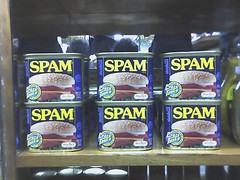
Spam image originally uploaded as: http://www.flickr.com/photos/pe5pe/59398685/

Labels: , ,